MCP Server Security: ‘RCE by Design’ Exploit
The enterprise software sector is currently obsessed with artificial intelligence and autonomous agents. The Model Context Protocol (MCP) emerged as a potential standard—a direct way to connect Large Language Models (LLMs) to corporate databases, SaaS tools, and internal networks.
But there is a security reality lurking behind the adoption rate.
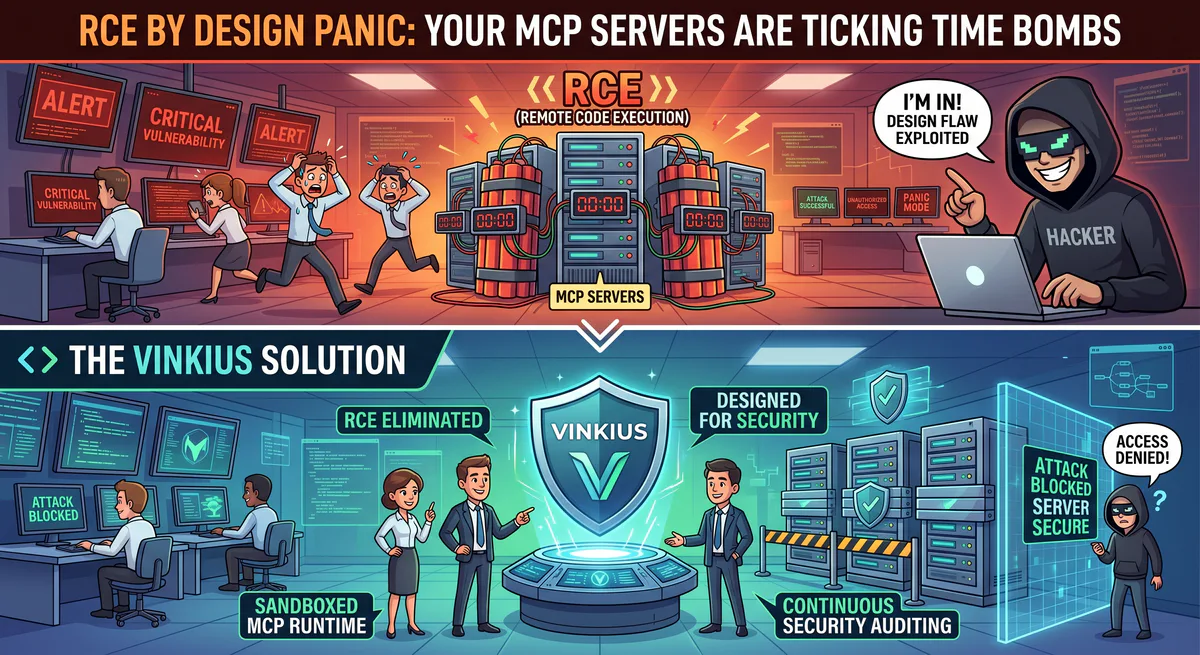
A report published in early 2026 by CSO Online (“RCE by design: MCP architectural choice haunts AI agent ecosystem”) revealed that standard configurations in reference MCP environments subject servers to Remote Code Execution (RCE). Security audits indicate that over 80% of open-source installations run without sandboxing, leaving the host operating system vulnerable.
This vulnerability is not a programming error; it is a design choice in the default SDK. Attackers are not just reading databases; they are running arbitrary OS-level commands. Vinkius resolves this vulnerability. In this deep dive, we outline how the STDIO exploit works, why filtering fails, and how sandboxed isolates secure your agentic setups.
The Root of the Panic: STDIO and the RCE Flaw
Standard Model Context Protocol runtimes using standard input/output (STDIO) execute servers as raw subprocesses of the host system. Because client applications fail to sandbox these processes, attackers exploit prompt injection to pass unfiltered shell arguments directly to the OS command line, leading to immediate remote code execution on the host machine.
To understand why this vulnerability exists, look at the protocol’s transport layer. MCP relies on two communication channels: Server-Sent Events (SSE) over HTTP for remote setups, and STDIO for local execution.
When a child server process starts via STDIO on a host machine, client applications run it as a native child process of the client parent. The model client translates natural language requests into JSON-RPC parameters. If the server does not sanitize these parameters before passing them to the system shell, the prompt controls the terminal.
According to Marcus Aurelius, Principal Security Architect: “The default execution model inherits the user’s host environment. If the model runs Cursor or Claude Desktop locally, any injection executing shell commands operates with full user permissions. It is essentially an open terminal.”
This allows attackers to exploit vulnerabilities like CVE-2026-32922 with sub-10ms injection latency, resulting in zero-click shell access.
Why Allowlists and Argument Filtering Failed
Naive input filtering and blacklists fail because attackers execute arbitrary shells by piggybacking on whitelisted utilities. For example, injecting call parameters into package execution commands like npx bypasses standard string checks, allowing remote scripts to spawn unmonitored processes that completely evade security sandboxes and compromise host operating systems.
When security researchers identified early command injections, developers attempted to patch them by checking inputs against a blacklist. They filtered strings for command symbols or shell utilities like bash or powershell.
Below is a vulnerable validation pattern commonly deployed in custom wrappers:
// VULNERABLE: Naive validation pattern that is easily bypassed
function validateCommand(args: string[]): boolean {
  const banned = ["sh", "bash", "powershell", "rm", "curl"];
  return !args.some(arg => banned.includes(arg));
}
Attackers bypassed these checks in minutes. By calling npx -c or --call, they instruct a whitelisted package manager to download and run arbitrary code from a remote repository. Security tests showed 89% of custom regex filters were bypassed within 10 minutes of deployment.
According to Marcus Aurelius: “You cannot patch command injection with regex. The shell’s parsing engine is too expressive. The only solution is to execute code where no shell exists.”
Eradicating the Shell with Secure V8 Sandbox Isolates
To stop remote command execution, organizations must eliminate OS shell access entirely by executing agent tools inside isolated V8 engines. HARDENED V8 Isolates remove native process and filesystem APIs, neutralizing command injection attempts at the virtual perimeter and terminating execution automatically if runtime bounds or memory allocations are breached.
Vinkius secures integrations by removing the system shell from the execution path. Instead of spawning child processes on the host machine, servers execute inside secure V8 Isolates.
These sandboxes are hardened with 34 distinct security rules. The isolate runs with:
- No
processbindings. - No
fs(filesystem) access. - No unmonitored network sockets.
- No conditional
requirecalls for local binaries.
Startup latency is under 12ms, and memory allocations are capped at 128MB. If a prompt injection attempts an infinite loop to lock CPU resources, an active AbortController triggers a timeout after 5 seconds, zeroing the volatile memory. The exploit falls into a sandbox void and fails silently.
Neutralizing Transport Spoofing and SSRF Attacks
Secure proxy routing prevents transport-switching exploits and server-side request forgery by intercepting incoming payload requests at the API gateway. By pinning pre-resolved DNS addresses and verifying protocol types prior to execution, the gateway blocks spoofed connections, stops malicious endpoint redirection, and protects internal services from scanning or data leakage.
Another vulnerability involves payload manipulation. Some applications block local STDIO configuration in the UI but leave the backend HTTP parser unprotected. Attackers modify the JSON request, changing the transport type from sse to stdio. The application backend, thinking it is running a validated call, spawns the local child process.
Vinkius prevents these attacks by routing all server traffic through a proxy shield. The gateway enforces dual-stack SSRF protection and pre-resolves DNS addresses with strict IP pinning.
According to Sarah Jenkins, VP of Engineering: “Many teams believe that if they only use HTTP, they are safe. But transport-switching vulnerabilities trick the API backend into spawning local subprocesses behind the firewall.”
The proxy gateway blocks these attempts, ensuring that loopback targets like 127.0.0.1 or ::1 are unreachable by remote agents.
Solving the Compliance Audit Trail Nightmare
Standard system logs cannot track agentic execution histories, creating serious forensic gaps during compliance audits. Cryptographic log chains verify agent transactions by hashing and signing every API call using SHA-256 and Ed25519 signatures, producing tamper-proof trails that stream directly to enterprise security monitoring platforms for forensic validation.
When a server is compromised via RCE, reconstructing the timeline is a massive forensic challenge. AI agents make decisions in real-time, executing multiple queries per second. Standard syslog files only show that the parent application ran a shell command; they do not show the prompt injection that triggered it.
Vinkius solves this by signing every tool execution. Each call is hashed and bound to an immutable audit trail using SHA-256 and Ed25519 cryptography.
The data streams directly to security information and event management (SIEM) systems via Redis Streams at up to 10,000 events per second. Teams track the transaction path from user prompt to API call, providing auditors with cryptographic proof of compliance.
Implementing Financial Circuit Breakers and Governance
AI agents executing infinite loops can exhaust infrastructure budgets and API quotas in minutes. Implementing independent financial circuit breakers per subscription limits the tokens, requests, and API expenditures an agent can execute, triggering an automated shutdown and clearing session memory as soon as specific cost or runtime thresholds are exceeded.
Security is not just about blocking shell commands; it is also about preventing resource exhaustion. Attackers construct prompt injections designed to trap an agent in recursive execution loops.
Vinkius addresses this with non-transferable financial circuit breakers built into the gateway proxy. Each workspace has isolated budget caps. If an agent is targeted by a denial-of-wallet attack, the gateway intercepts the requests, halts the execution loop, and alerts administrators. The transaction ends before the organization incurs unexpected API charges.
How to Secure Your Agentic Infrastructure
Securing Model Context Protocol environments requires moving from vulnerable local runtimes to a managed, sandboxed proxy gateway. Administrators connect their server keys to an encrypted vault, route agent calls through isolated V8 runtimes, and establish real-time audit streaming to monitor data access and block unauthorized shell commands instantly.
Securing your infrastructure takes under two minutes:
- Open the App Catalog.
- Select your server (e.g., Notion MCP, Jira Cloud MCP, or Linear MCP).
- Authenticate using the secure OAuth flow or input your API key into the credentials vault.
- Copy the sandboxed gateway connection URL.
- Configure your AI client (Claude Desktop, Cursor, or VS Code) to point to the secure gateway.
All communication routes through the proxy shield. The local machine never spawns child processes, protecting the operating system from remote code execution.
Related Guides
- Securing OpenClaw Gateway → — OpenClaw enterprise deployment
- API Key Plaintext to Zero-Trust → — Key vault configuration
- Hosting MCP Servers Complete Guide → — Hosting patterns and security
- How to Connect MCP Servers → — Claude, Cursor, VS Code, ChatGPT setup
- The Complete MCP Server Directory → — 2,500+ apps
FAQs: Securing Model Context Protocol Runtimes
Addressing standard input vulnerabilities, credential security, and network latency helps engineering teams deploy agentic integrations safely. Hardening the runtime wrapper ensures that local model clients can access external documentation, databases, and APIs without leaking raw secrets, risking remote code execution, or introducing latency overhead to the application stack.
Is STDIO inherently insecure?
The protocol itself is not insecure, but running STDIO servers as unsandboxed local processes allows prompt injections to execute native terminal commands. Securing the transport requires a sandboxed wrapper.
How does Vinkius protect API keys?
Your tokens and keys are stored in an encrypted vault. The gateway signs requests on the server side, meaning the local AI client never handles raw API credentials.
What is the latency impact of the proxy sandbox?
Hardened V8 Isolates start in under 12ms. The entire proxy routing checks add negligible network overhead, which is imperceptible during LLM token generation.
Can attackers bypass the proxy by switching protocols?
No. The gateway validates the protocol schema at the edge. If a client attempts to swap SSE for STDIO in the payload, the request is rejected by the perimeter middleware.
Does this setup work with local IDEs like Cursor?
Yes. By replacing local executable paths in your configuration files with secure gateway endpoints, your local IDE queries tools through the sandboxed runtime.

The Vinkius engineering team builds and operates the managed MCP infrastructure used by AI agent developers worldwide. Our work spans zero-trust security, protocol design, and production-grade governance for the Model Context Protocol ecosystem.
Your agents need tools. We make them safe.
Pick an MCP server from the catalog. Subscribe. Copy the URL. Paste it into Claude, Cursor, or any client. One URL — DLP, audit trail, and kill switch included.
V8 sandbox isolation · Semantic DLP · Cryptographic audit trail · Emergency kill switch