Time-to-hire is the most expensive metric in talent acquisition. According to SHRM’s 2025 Talent Benchmark Report, the average time-to-hire for a software engineer is 44 days, and every day an engineering position remains open costs the company $680 in lost productivity. For a team hiring 10 engineers, that’s $299,200 in productivity loss — just from hiring delays.
The delays aren’t caused by lack of candidates. They’re caused by tool fragmentation. Sourcers find candidates on LinkedIn but can’t see the open reqs in Greenhouse. Recruiters manage pipelines in Greenhouse but can’t check headcount approvals in BambooHR. Scheduling coordinators juggle Calendly availability for 5 interviewers across time zones. Hiring managers ask for updates on Slack because they can’t access the ATS.
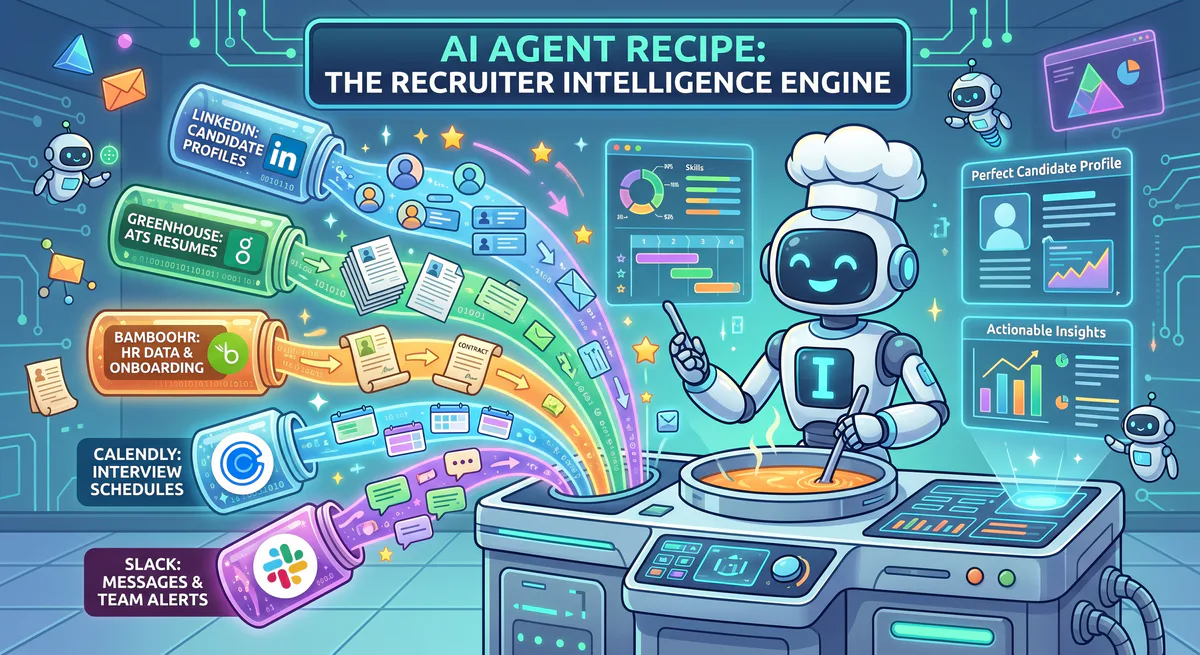
This recipe connects all five tools into a single AI conversation that answers the question a VP of Talent asks every Monday: “Where do we stand on hiring?”
The Recipe
| Component | MCP Server | Role |
|---|---|---|
| Candidate Intelligence | LinkedIn MCP | Sourcing, profile data, InMail tracking |
| Pipeline Management | Greenhouse MCP | Job openings, candidate stages, interview scorecards |
| Headcount & Org Data | BambooHR MCP | Approved headcount, org chart, compensation bands |
| Interview Scheduling | Calendly MCP | Availability, booked interviews, no-shows |
| Team Coordination | Slack MCP | Hiring channel updates, decision notifications |
Why These Tools Together Create Something New
LinkedIn alone shows you candidates. But it doesn’t know which roles you’re actually hiring for, whether the headcount is approved, or when your interviewers are free.
Greenhouse alone tracks your pipeline. But it can’t tell you if the salary band you’ve posted is competitive (BambooHR comp data), or if the candidate you’re about to lose has been waiting 6 days for a recruiter screen that hasn’t been scheduled (Calendly).
BambooHR alone knows approved headcount. But it can’t correlate empty positions with pipeline health in Greenhouse — you might have 3 approved engineering reqs with zero candidates in the pipeline.
The cross-tool correlation the AI provides:
- Pipeline velocity × scheduling bottleneck — Which candidates are stalling because interviews haven’t been scheduled?
- Headcount approval × pipeline coverage — Which approved roles have no sourcing activity?
- Offer stage × comp band validation — Is the offer we’re about to make within the approved salary range?
- Interview-to-offer ratio × channel performance — Which sourcing channels produce candidates that actually get hired?
Real-World Scenarios
Scenario 1: Monday Hiring Stand-up
The VP of Talent asks at Monday’s team sync:
“Give me the full hiring dashboard: all open roles, pipeline stages per role, candidates at risk, and interview scheduling bottlenecks. Post the summary to #hiring.”
AI response: “Hiring Dashboard — Week of April 14, 2026:
Open Roles (Greenhouse + BambooHR):
| Role | Department | Pipeline | Top of Funnel | Screen | Interview | Offer | Days Open |
|---|---|---|---|---|---|---|---|
| Sr. Backend Engineer | Engineering | 24 candidates | 12 | 6 | 4 | 2 | 28 |
| Product Designer | Design | 8 candidates | 3 | 2 | 3 | 0 | 42 ⚠️ |
| DevOps Engineer | Platform | 15 candidates | 8 | 4 | 2 | 1 | 19 |
| Account Executive | Sales | 31 candidates | 18 | 7 | 4 | 2 | 14 |
| Marketing Manager | Marketing | 5 candidates | 2 | 1 | 2 | 0 | 51 🔴 |
🔴 At-risk roles:
- Marketing Manager (51 days open, only 5 candidates in pipeline). BambooHR confirms this headcount was approved on Feb 22 — 51 days with no offer. Sourcing needs urgent attention.
- Product Designer (42 days, no candidates at offer stage). 3 candidates in interviews, but Calendly shows the design director has blocked all interview slots until April 21 (offsite). Scheduling bottleneck.
⚡ Candidates at risk (waiting >5 days):
- Maria C. (Sr. Backend) — moved to ‘Interview’ stage 7 days ago but no Calendly event booked. Last Greenhouse note: ‘Strong candidate, need to schedule panel.’ Action: Schedule panel interview today.
- James K. (Account Executive) — received offer 5 days ago, no response. LinkedIn shows he updated his profile 2 days ago (possible counter-offer signal). Action: Recruiter follow-up call.
Scheduling health (Calendly):
- 12 interviews scheduled this week
- 3 interviewers have zero availability this week (blocked calendars)
- Average time from ‘move to interview’ to ‘interview scheduled’: 3.8 days (target: 2 days)
Posted to #hiring ✅“
Scenario 2: Candidate Pipeline Deep-Dive
“Show me all Backend Engineer candidates in the pipeline. For each candidate at Interview stage, cross-reference their LinkedIn profile with our salary band in BambooHR. Are we at risk of losing anyone on compensation?”
AI response: “Backend Engineer Pipeline — Compensation Risk Analysis:
BambooHR salary band: $145,000 - $185,000 (Senior), $120,000 - $155,000 (Mid)
| Candidate | Stage | LinkedIn Title | Current Company | Est. Current Comp | Our Band | Risk |
|---|---|---|---|---|---|---|
| Maria C. | Interview | Sr. Engineer | FAANG Co. | ~$190K+ | $145-185K | 🔴 HIGH — likely above our band |
| David L. | Interview | Backend Lead | Series B Startup | ~$165K | $145-185K | ✅ Within band |
| Sarah T. | Interview | Engineer II | Mid-Market SaaS | ~$135K | $120-155K | ✅ Good fit |
| Alex P. | Interview | Sr. SDE | Big Tech | ~$200K+ | $145-185K | 🔴 HIGH — well above band |
Compensation risk: 2 of 4 interview candidates may be above our salary band. Maria C. (FAANG) and Alex P. (Big Tech) likely expect $185K+.
Recommendations:
- For Maria C.: If she’s a strong hire, present the role with equity/RSU component to bridge the gap. Before the panel, confirm with BambooHR if a band exception is pre-approved.
- For Alex P.: Same — or consider whether the role scope justifies a Senior/Staff-level band.
- For David L. and Sarah T.: Both within band — move quickly to offer if interviews are positive.”
Scenario 3: Interview-to-Hire Funnel Analysis
“What’s our conversion rate at each pipeline stage? Which sourcing channels have the best interview-to-offer conversion? Compare Q1 this year vs. last year.”
AI response: “Hiring Funnel Analysis (Greenhouse) — Q1 2026 vs. Q1 2025:
Pipeline conversion rates:
| Stage | Q1 2025 | Q1 2026 | Trend |
|---|---|---|---|
| Applied → Screen | 22% | 18% | ⚠️ -4% (more unqualified applicants) |
| Screen → Interview | 45% | 52% | ✅ +7% (better screening) |
| Interview → Offer | 28% | 31% | ✅ +3% |
| Offer → Accept | 72% | 64% | 🔴 -8% (losing more offers) |
| Overall (Applied → Hire) | 2.03% | 1.84% | ⚠️ -0.19% |
Offer acceptance is the bottleneck. We’re losing 36% of offers (up from 28% last year).
Offer rejection reasons (Greenhouse notes):
- ‘Took another offer’ — 45% (competitive market)
- ‘Compensation too low’ — 30% (band issue)
- ‘Changed mind about role’ — 15%
- ‘Relocation concerns’ — 10%
Sourcing channel quality:
| Channel | Candidates | Hires | Conversion | Avg Time-to-Hire |
|---|---|---|---|---|
| LinkedIn (sourced) | 142 | 8 | 5.6% | 32 days |
| Referrals | 38 | 6 | 15.8% ✅ | 24 days |
| Job boards (Indeed, etc.) | 310 | 4 | 1.3% | 48 days |
| Career page (organic) | 89 | 3 | 3.4% | 38 days |
Key insight: Referrals convert 3x better than LinkedIn sourcing and close 8 days faster. Consider: increasing referral bonus to drive more referral volume.”
Security Considerations
Recruiting data is exceptionally sensitive:
- Candidate PII (names, emails, phone numbers, compensation data) — DLP rules auto-redact
- Internal salary bands — accessible for comparison but protected from logging
- Interview scorecards — contain subjective assessments, protected
- LinkedIn credentials — stored in encrypted vault, never visible to AI
- EEOC/diversity data — automatically excluded from AI responses per compliance rules
- Audit trail — every query logged for compliance
How to Set It Up
- Go to our App Catalog
- Subscribe:
- Paste URLs into Claude, Cursor, or ChatGPT
- Ask: “Show me all open roles with pipeline health.”
Variations
- Lever instead of Greenhouse → Lever MCP
- Workday instead of BambooHR → Workday MCP
- Deel for global/remote hiring → Deel MCP
Related Guides
- HR MCP Servers → — Full HR cluster
- Revenue Intelligence Recipe → — Finance recipe
- How to Connect MCP Servers → — Setup guide
- The MCP Server Directory → — 2,500+ apps
Your agents need tools. We make them safe.
Pick an MCP server from the catalog. Subscribe. Copy the URL. Paste it into Claude, Cursor, or any client. One URL — DLP, audit trail, and kill switch included.
V8 sandbox isolation · Semantic DLP · Cryptographic audit trail · Emergency kill switch