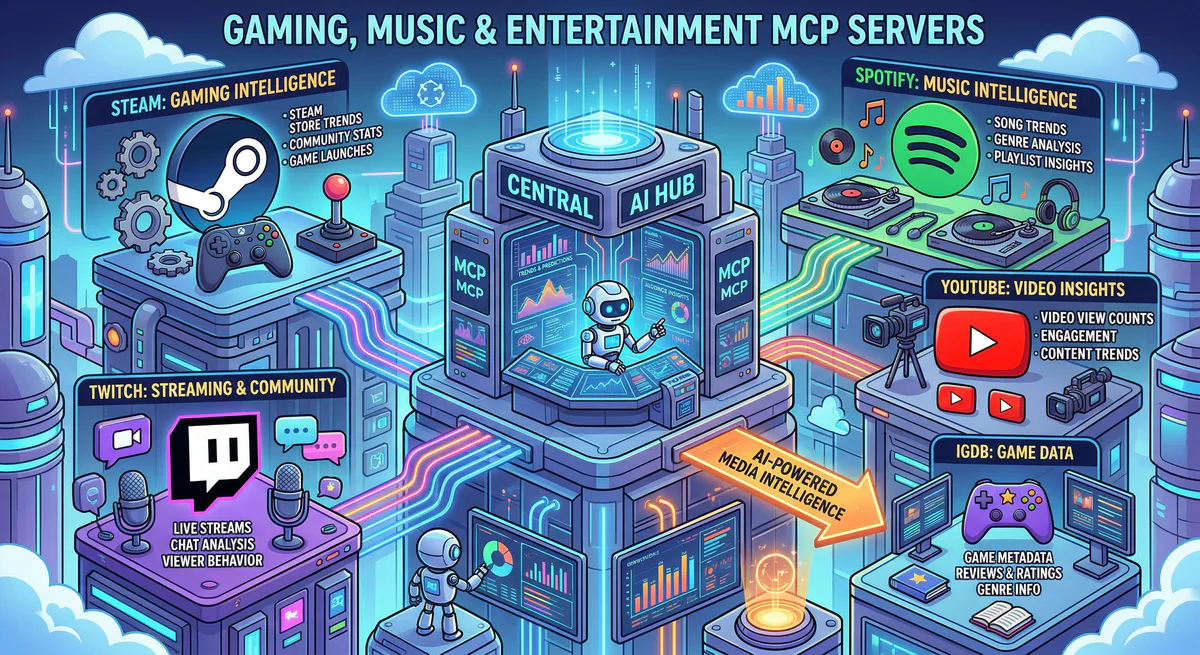
The global entertainment industry generates $2.8 trillion in annual revenue across gaming ($190B), music ($28B), video streaming ($100B+), and digital content creation ($250B+). Every platform — Steam, Twitch, Spotify, YouTube — has its own analytics dashboard, its own audience metrics, and its own version of “engagement.”
For content creators, game studios, music labels, and media companies, the challenge isn’t lack of data — it’s data fragmentation. A Twitch streamer who also publishes on YouTube and has music on Spotify needs to check three dashboards to understand their total audience. A game studio launching a title needs to monitor Steam reviews, Twitch viewership, and YouTube coverage simultaneously.
AI agents connected via MCP unify everything:
“How did my stream perform on Twitch last night? Compare with my YouTube video performance this week. Check Spotify for streams of my intro music. Give me a total audience reach across all platforms.”
One prompt. Three platforms. A creator intelligence dashboard that no single platform provides.
We host these servers in our App Catalog.
The Entertainment MCP Landscape
Gaming
| Platform | MCP Server | What it provides |
|---|---|---|
| Steam | Steam MCP | Game data, player counts, pricing, community |
| Steam Market | Steam Economy MCP | Item trading, market data, economy trends |
| Steam Scouting | Steam Scouting MCP | Game performance analytics, genre trends |
| Steam Hype | Steam Hype MCP | Wishlist trends, upcoming release hype |
| IGDB | IGDB Global Gaming Database MCP | Game metadata, ratings, screenshots, cross-platform |
| RAWG | RAWG Video Games Database MCP | 500K+ games, cross-platform database |
| GamerPower | GamerPower Giveaways MCP | Free games, loot, giveaway tracking |
| NetEase | NetEase Cloud Gaming MCP | Chinese gaming market intelligence |
Music & Audio
| Platform | MCP Server | What it provides |
|---|---|---|
| Spotify | Spotify Music MCP | Streams, playlists, artist data, audio features |
| ACRCloud | ACRCloud Music Recognition MCP | Audio fingerprinting, music identification |
| AudD | AudD Music Recognition MCP | Song recognition, lyrics search |
| Audiomack | Audiomack Music MCP | Independent artist platform, trending tracks |
| MusicBrainz | MusicBrainz MCP | Music metadata, discographies, recordings |
| Podbean | Podbean Hosting MCP | Podcast hosting, analytics, monetization |
| Podchaser | Podchaser MCP | Podcast discovery, ratings, guest database |
Video & Streaming
| Platform | MCP Server | What it provides |
|---|---|---|
| YouTube | YouTube MCP | Video analytics, channel data, comments, playlists |
| Twitch | Twitch MCP | Live streams, channel analytics, chat, clips |
| Loom | Loom Video MCP | Async video messaging, workspace analytics |
Deep-Dive: Game Market Intelligence
Real-World Workflow: Steam Launch Analysis
A game studio preparing for launch:
“Analyze the market for our upcoming roguelike deckbuilder on Steam. What’s the average player count for similar games? What’s the optimal price point? Which competitor games have the best review scores, and what do players praise most?”
AI response (Steam + IGDB + RAWG): “Roguelike Deckbuilder Market Analysis — Steam (April 2026):
Market size: 127 active roguelike deckbuilders on Steam. 34 launched in the last 12 months.
Top performers (current players):
| Game | Avg Players (30d) | Peak | Reviews | Price | Revenue Est. |
|---|---|---|---|---|---|
| Slay the Spire 2 | 42,100 | 98,400 | 96% positive | $29.99 | $85M+ |
| Balatro | 18,400 | 45,200 | 97% positive | $14.99 | $42M+ |
| Inscryption | 2,800 | 12,400 | 97% positive | $19.99 | $28M+ |
| Monster Train | 1,200 | 8,900 | 91% positive | $24.99 | $15M+ |
Pricing analysis:
- Average price in genre: $18.40
- Median price: $14.99
- Games priced $14.99 have 2.3x more reviews than games at $24.99+
- Optimal price recommendation: $14.99-$19.99 (balances conversion rate with revenue per unit)
Review sentiment analysis (top praise themes):
- ‘Runs feel unique’ (mentioned in 38% of positive reviews) — replayability is the #1 factor
- ‘One more run’ (26%) — addictiveness / game loop quality
- ‘Great synergies’ (22%) — card/ability combo discovery
- ‘Art style’ (18%) — visual identity matters
Review sentiment (top criticism):
- ‘Gets repetitive after 40 hours’ (31% of negative reviews)
- ‘Too much RNG’ (24%)
- ‘Balance issues’ (19%)
Competitor wishlists (Steam Hype):
- 12 upcoming roguelike deckbuilders with 5K+ wishlists
- Your closest competitor ‘DeckForge’ has 28K wishlists (launching May 15)
- Window recommendation: Launch before May 15 to avoid direct competition.”
Deep-Dive: Creator Cross-Platform Analytics
Real-World Workflow: Content Creator Dashboard
“I’m a Twitch streamer who also publishes highlights on YouTube and has intro music on Spotify. Give me a weekly cross-platform report.”
AI response: “Creator Intelligence Report — April 7-14, 2026:
🎮 Twitch:
- Total stream hours: 32
- Average concurrent viewers: 847 (↑12% vs. last week)
- Peak viewers: 2,340 (Friday night Valorant tournament)
- New followers: 489 | Subscribers: 34 (Tier 1: 28, Tier 2: 4, Tier 3: 2)
- Clip views: 12,400 across 8 clips
- Top clip: ‘Insane clutch ace’ — 4,200 views, 340 shares
📹 YouTube:
- Videos published: 3 (2 stream highlights, 1 tutorial)
- Total views: 28,400 (↑8%)
- Watch time: 1,240 hours
- New subscribers: 312
- Best performing: ‘Valorant Ultimate Settings Guide’ — 18,200 views, 8.2% CTR, 62% retention
🎵 Spotify (intro track):
- Streams this week: 2,340 (↑18% — correlating with Twitch growth)
- Monthly listeners: 4,200
- Playlist adds: 12 this week
📊 Total audience reach:
| Platform | Reach | Primary Value |
|---|---|---|
| Twitch | 847 avg live | Real-time engagement, subs revenue |
| YouTube | 28,400 weekly views | Discovery + passive revenue |
| Spotify | 2,340 weekly streams | Music income + brand presence |
| Combined | ~31,587 | Multi-platform presence |
Key insight: Your YouTube tutorial (18.2K views) outperformed your stream highlights (10K combined). Tutorials have 3.2x the discovery potential on YouTube. Recommendation: Create 1 tutorial per week alongside stream highlights.
🎵 Spotify-Twitch correlation: Your Spotify streams increased 18% this week — same week your Twitch grew 12%. Viewers are finding your music through streams. Consider: ‘Now Playing’ overlay on Twitch linking to Spotify.”
Deep-Dive: Music Analytics
Real-World Workflow: Artist Intelligence
“Check Spotify for my latest single’s performance. Compare with my previous releases. Find playlists that added the track. Search MusicBrainz for metadata accuracy.”
AI response (Spotify + MusicBrainz): “Single performance — ‘Midnight Circuit’ (released April 1):
Spotify (14-day stats):
- Total streams: 12,400
- Daily average: 886 streams/day (↑ from ‘Neon Dreams’ at 640/day)
- Save rate: 24% (excellent — benchmark is 15%)
- Skip rate: 18% (benchmark: 30%) — listeners are completing the track ✅
Comparison with previous releases:
| Track | First 14 Days | Save Rate | Peak Daily | Playlist Adds |
|---|---|---|---|---|
| Midnight Circuit | 12,400 | 24% | 1,200 | 8 |
| Neon Dreams | 8,960 | 18% | 890 | 5 |
| Digital Rain | 6,200 | 14% | 720 | 3 |
Playlist discovery (Spotify):
- Added to 8 editorial/user playlists this week:
- ‘Synthwave Essentials’ (42K followers) — added Apr 8
- ‘Late Night Coding’ (18K followers) — added Apr 10
- ‘New Synth’ (12K followers) — added Apr 6
MusicBrainz metadata: ✅ Correct. Artist, release date, ISRC, genre tags all accurate.
Growth trajectory: ‘Midnight Circuit’ is your best-performing release by 38%. The 24% save rate indicates strong listener affinity. Recommendation: Pitch to ‘Release Radar’ and ‘Discover Weekly’ Algorithm via Spotify for Artists.”
Multi-Tool Workflow Table
| Workflow | Tools Combined | What You Ask |
|---|---|---|
| Game launch market research | Steam + IGDB + RAWG | ”Analyze the market for our genre” |
| Cross-platform creator report | Twitch + YouTube + Spotify | ”Weekly audience analytics across all platforms” |
| Music release analytics | Spotify + MusicBrainz + Audiomack | ”How’s the new single performing?” |
| Podcast growth tracking | Podbean + Podchaser + YouTube | ”Episode downloads vs. YouTube clip views” |
| Game economy monitoring | Steam Economy + Steam Scouting | ”Item price trends, trading opportunities” |
| Esports content planning | Twitch + PandaScore + YouTube | ”Upcoming tournaments and content opportunities” |
Security for Entertainment Data
- Streaming credentials (Twitch API, YouTube OAuth, Spotify API) stored in encrypted vault
- Revenue data (ad revenue, sub revenue, royalties) accessible but audit-logged
- Player data (Steam IDs, game hours) protected by DLP
- Kill switch — revoke any platform connection instantly
How to Set It Up
- Go to our App Catalog
- Subscribe to your platforms:
- Gaming: Steam MCP | IGDB MCP | Twitch MCP
- Music: Spotify MCP | MusicBrainz MCP | Podbean MCP
- Video: YouTube MCP | Loom MCP
- Copy URLs → paste into Claude, Cursor, or ChatGPT
Internal Linking: Related Guides
- Sports & eSports MCP Servers → — PandaScore, The Odds API
- Social Media MCP Servers → — Instagram, TikTok, LinkedIn
- Brand & Design MCP Servers → — Frontify, Bynder
- The Complete MCP Server Directory → — 2,500+ apps
Start Building Your Entertainment Intelligence Agent
Your audience is spread across every platform. Your analytics shouldn’t be.
Need a custom entertainment setup? Email support@vinkius.com.
Your agents need tools. We make them safe.
Pick an MCP server from the catalog. Subscribe. Copy the URL. Paste it into Claude, Cursor, or any client. One URL — DLP, audit trail, and kill switch included.
V8 sandbox isolation · Semantic DLP · Cryptographic audit trail · Emergency kill switch