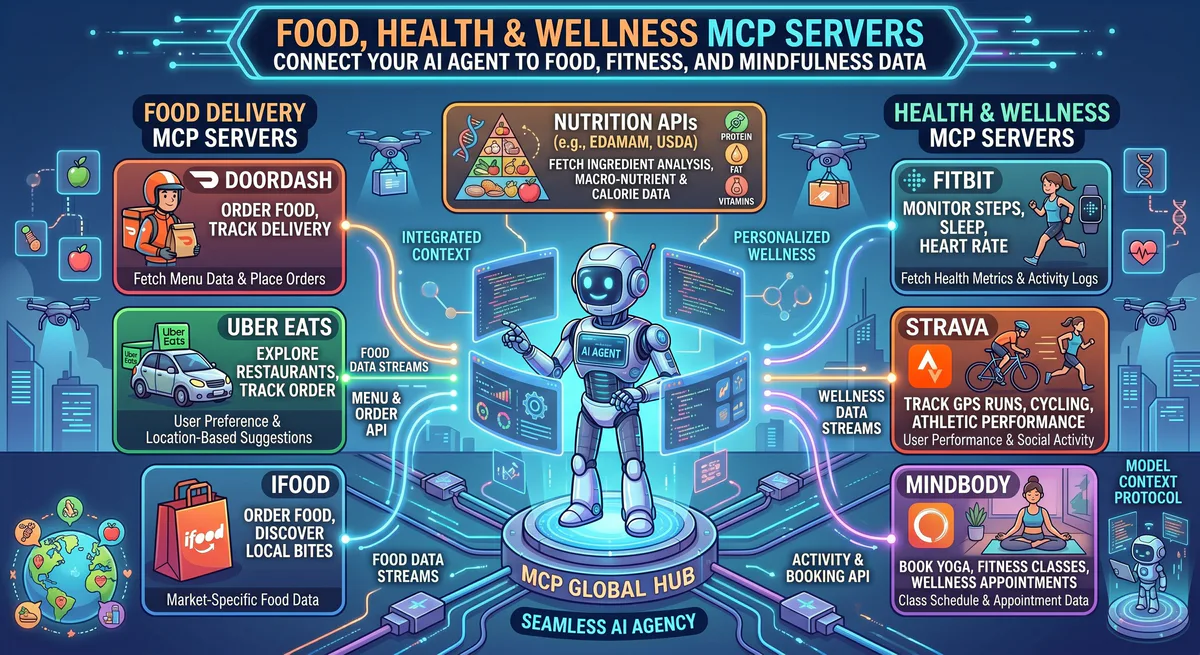
Food delivery, health tracking, and wellness represent three converging mega-trends of the 2020s. DoorDash, Uber Eats, and iFood collectively process over 15 million orders per day globally. Fitbit and Strava have 100M+ active users tracking steps, heart rate, and workouts. Mindbody powers 75,000+ wellness businesses. USDA FoodData Central is the gold standard for nutritional analysis.
These systems generate enormous amounts of personal and business data — but they don’t talk to each other. Your food delivery operations don’t connect to your nutrition data. Your fitness tracker doesn’t know what you ate for lunch. Your wellness business analytics in Mindbody don’t correlate with your delivery operations.
AI agents connected via MCP change this:
“Show me yesterday’s DoorDash delivery performance: orders completed, average delivery time, driver utilization. Then check my Fitbit data — how many steps did I take, what was my sleep score, and based on my activity level, what should my calorie target be today?”
Personal health intelligence + business operations analytics — unified in one conversation.
We host these servers in our App Catalog.
The Food, Health & Wellness MCP Landscape
Food Delivery & Nutrition
| Platform | MCP Server | Coverage |
|---|---|---|
| DoorDash | DoorDash Drive MCP | Last-mile delivery (US, Canada, Australia) |
| Uber Eats | Uber Eats MCP | Global food delivery + restaurant management |
| iFood | iFood MCP | Brazil’s largest food delivery platform |
| FoodPanda | FoodPanda MCP | Asia-Pacific food delivery |
| GrabFood | GrabFood Partner MCP | Southeast Asian food delivery |
| GoFood | GoFood MCP | Indonesia food delivery |
| USDA FoodData | USDA FoodData Central MCP | 350K+ foods, complete nutritional data |
| Open Food Facts | Open Food Facts MCP | 3M+ products, ingredients, Nutri-Score |
Health & Fitness
| Platform | MCP Server | What it tracks |
|---|---|---|
| Fitbit | Fitbit MCP | Steps, heart rate, sleep, SpO2, activity zones |
| Strava (Training) | Strava Training MCP | Runs, rides, swims, training load |
| Strava (Social) | Strava Social MCP | Clubs, kudos, leaderboards |
| Strava (Planning) | Strava Planning MCP | Routes, segments, course planning |
| Mindbody | Mindbody MCP | Gym/studio bookings, memberships, staff scheduling |
| yMove Fitness | yMove Fitness MCP | Movement analytics, exercise tracking |
| Health Gorilla | Health Gorilla MCP | Clinical data, lab results, health records |
| CDC Public Health | CDC Public Health MCP | Public health statistics, outbreak data |
| Healthcare.gov | Healthcare.gov MCP | US health insurance marketplace data |
Deep-Dive: Food Delivery Operations
Real-World Workflow: Restaurant Delivery Dashboard
For restaurant owners or ghost kitchen operators using multiple delivery platforms:
“Compare my performance across DoorDash and Uber Eats yesterday. Orders completed, average delivery time, customer ratings, and revenue. Which platform is more profitable?”
AI response: “Multi-platform delivery performance — April 13, 2026:
| Metric | DoorDash | Uber Eats | Total |
|---|---|---|---|
| Orders completed | 87 | 64 | 151 |
| Revenue (before fees) | $3,480 | $2,560 | $6,040 |
| Platform fees | $696 (20%) | $768 (30%) | $1,464 |
| Net revenue | $2,784 | $1,792 | $4,576 |
| Average order value | $40.00 | $40.00 | $40.00 |
| Avg delivery time | 28 min | 34 min | — |
| Customer rating | 4.7★ | 4.5★ | — |
| Cancellation rate | 2.3% | 4.7% | — |
Key insights:
- DoorDash is significantly more profitable. Same average order value, but 10% lower platform fees = $12 more net revenue per order.
- Uber Eats has longer delivery times and higher cancellations. 34 min avg vs. 28 min on DoorDash — likely a driver availability issue in your zone.
- Revenue opportunity: If you could shift 20 orders from Uber Eats to DoorDash (keeping total volume), you’d save $240/day in fees = $7,200/month.
Recommendation: Consider making DoorDash your primary platform and reducing Uber Eats hours to peak-only (lunch 11-2, dinner 6-9).”
Deep-Dive: Personalized Health Intelligence
Real-World Workflow: AI Health Coach
By connecting fitness tracking with nutritional data, the AI becomes a personalized health intelligence system:
“Check my Fitbit data for the last 7 days. Show me steps, resting heart rate, sleep quality, and active zone minutes. Based on my activity level, calculate my TDEE and suggest today’s macro targets. Check USDA for a meal plan that fits.”
AI response: “Health intelligence — Week of April 7-14, 2026:
Fitbit overview:
| Day | Steps | RHR | Sleep Score | Active Zone Min | Calories Burned |
|---|---|---|---|---|---|
| Mon | 8,420 | 62 | 78/100 | 32 | 2,340 |
| Tue | 12,100 | 60 | 82/100 | 45 | 2,680 |
| Wed | 6,800 | 63 | 71/100 ⚠️ | 18 | 2,120 |
| Thu | 9,400 | 61 | 85/100 | 38 | 2,450 |
| Fri | 11,200 | 59 | 88/100 | 52 | 2,720 |
| Sat | 14,600 | 58 | 90/100 | 67 | 3,100 |
| Sun | 5,200 | 64 | 76/100 | 12 | 1,980 |
Weekly averages: 9,674 steps | 61 bpm RHR | 81.4 sleep score | 37.7 AZM
TDEE calculation: Based on your average calorie burn (2,484/day), weight (82 kg), and activity level (moderate):
- TDEE: ~2,500 kcal/day
- For fat loss (-0.5 kg/week): 2,000 kcal
- For maintenance: 2,500 kcal
- For muscle gain (+0.25 kg/week): 2,750 kcal
Today’s macro targets (maintenance):
| Macro | Grams | Calories | % |
|---|---|---|---|
| Protein | 165g | 660 | 26% |
| Carbs | 290g | 1,160 | 47% |
| Fat | 75g | 675 | 27% |
| Total | — | 2,495 | 100% |
Sample meal plan (USDA FoodData):
- Breakfast: 3 eggs scrambled (210 cal, 18g protein) + 2 slices whole wheat toast (160 cal) + 1 banana (105 cal) = 475 cal
- Lunch: Grilled chicken breast 200g (330 cal, 62g protein) + brown rice 150g (166 cal) + mixed greens salad with olive oil (180 cal) = 676 cal
- Snack: Greek yogurt 200g (130 cal, 20g protein) + handful almonds 30g (170 cal) = 300 cal
- Dinner: Salmon fillet 180g (367 cal, 40g protein) + sweet potato 200g (172 cal) + steamed broccoli 150g (51 cal) = 590 cal
- Evening: Protein shake (250 cal, 30g protein) + apple (95 cal) = 345 cal
Total: 2,386 cal | 170g protein ✅ | Fits your maintenance target.”
Deep-Dive: Wellness Business Analytics
Real-World Workflow: Mindbody Studio Performance
“Show me this week’s performance at the studio: bookings, attendance rate, top classes, and membership growth.”
AI response (Mindbody): “Studio performance — April 7-14, 2026:
| Metric | This week | Last week | Trend |
|---|---|---|---|
| Total bookings | 342 | 318 | ✅ +7.5% |
| Attendance rate | 81% | 78% | ✅ +3% |
| No-shows | 34 (10%) | 41 (13%) | ✅ Improving |
| New memberships | 8 | 5 | ✅ +60% |
| Cancellations | 2 | 3 | ✅ -33% |
Top classes by booking:
- Yoga Flow (Mon/Wed/Fri 7 AM) — 28 bookings each, waitlist: 4
- HIIT Circuit (Tue/Thu 6 PM) — 24 bookings each
- Pilates Reformer (Sat 9 AM) — 22 bookings, waitlist: 7
⚡ Opportunity: Yoga Flow and Pilates both have waitlists. Consider adding a second time slot.”
Multi-Tool Workflow Table
| Workflow | Tools Combined | What You Ask |
|---|---|---|
| Multi-platform delivery comparison | DoorDash + Uber Eats | ”Compare performance across delivery platforms” |
| Personalized health coaching | Fitbit + USDA FoodData | ”Calculate my nutrition needs based on my activity” |
| Meal + workout planning | Strava + USDA + Open Food Facts | ”Plan meals around my training schedule” |
| Restaurant profit analysis | DoorDash + Uber Eats + Google Sheets | ”Which platform is most profitable? Track in Sheets” |
| Studio member engagement | Mindbody + Slack | ”Attendance trends, alert on low-performing classes” |
| Regional food delivery insights | iFood + FoodPanda + GrabFood | ”Compare delivery trends across Brazil, Thailand, Indonesia” |
Security & HIPAA Considerations
Health data is among the most regulated information globally. HIPAA in the US, GDPR health provisions in Europe, and LGPD in Brazil all impose strict requirements.
- Health metrics (heart rate, sleep, SpO2) classified as PHI — enhanced DLP rules
- Nutrition preferences and dietary restrictions treated as sensitive personal data
- Delivery order history protected to prevent location pattern analysis
- All credentials (Fitbit OAuth, DoorDash API, Strava tokens) stored in encrypted vault
- No data retention — we do not cache or store health or nutrition data
- Kill switch available for all connections
How to Set It Up
- Go to our App Catalog
- Subscribe to your platforms — Food, Health, or both:
- Food: DoorDash MCP | Uber Eats MCP | iFood MCP
- Nutrition: USDA FoodData MCP | Open Food Facts MCP
- Health: Fitbit MCP | Strava Training MCP | Mindbody MCP
- Copy URLs → paste into Claude, Cursor, or ChatGPT
Internal Linking: Related Guides
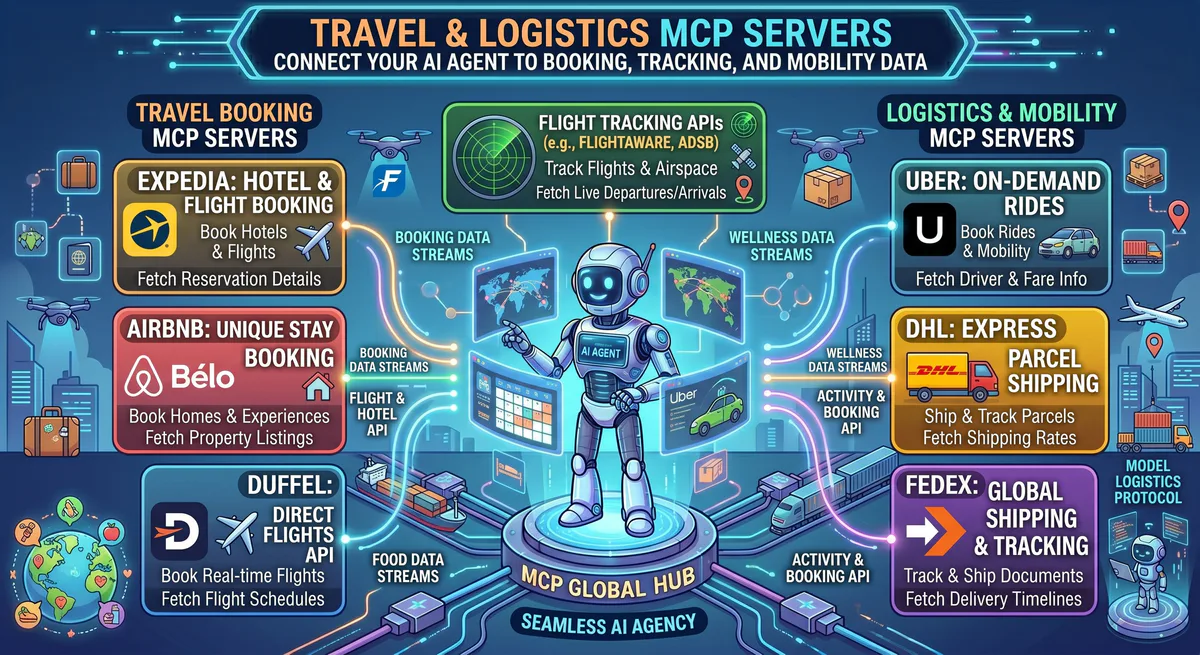
- Travel & Logistics MCP Servers → — Expedia, Airbnb, FlightAware
- E-Commerce MCP Servers → — Shopify, WooCommerce
- Database MCP Servers → — Supabase, PostgreSQL, MongoDB
- The Complete MCP Server Directory → — 2,500+ apps
Start Building Your Health & Food Intelligence Agent
Your health data, your nutrition, your delivery business — unified in one AI conversation.
Need a custom health or food delivery setup? Email support@vinkius.com.
Your agents need tools. We make them safe.
Pick an MCP server from the catalog. Subscribe. Copy the URL. Paste it into Claude, Cursor, or any client. One URL — DLP, audit trail, and kill switch included.
V8 sandbox isolation · Semantic DLP · Cryptographic audit trail · Emergency kill switch