The cryptocurrency market operates 24/7/365 across hundreds of exchanges, thousands of tokens, and an increasingly complex DeFi landscape. No human can monitor all of it. According to CoinGecko’s 2025 Annual Report, the average active crypto trader checks prices 47 times per day across 3.2 different exchanges — a behavior pattern that screams for automation.
But crypto automation has historically meant one of two things: either trusting a black-box trading bot with your API keys (dangerous), or writing custom scripts that break every time an exchange updates their API (exhausting).
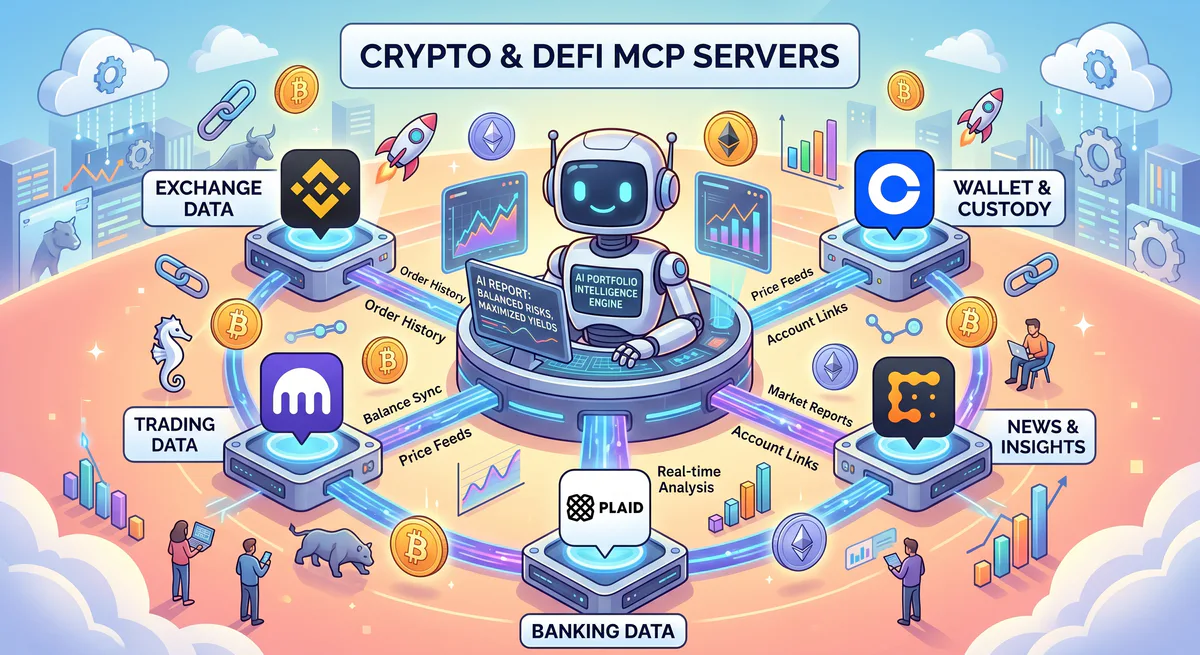
AI agents connected to crypto exchanges via MCP offer a third path: conversational portfolio intelligence. You don’t hand over trading authority to a bot. You ask questions, get answers, and make decisions — with the AI reading real-time data from every exchange simultaneously:
“What’s my total portfolio value across Binance and Coinbase? Which positions are up more than 20%? Are there any arbitrage opportunities between exchanges right now? Show me my DeFi yield positions.”
One prompt. Multiple exchanges. A portfolio intelligence layer that no single exchange dashboard provides — because no single exchange shows you data from the competition.
We host production-grade, governed MCP servers for every major crypto platform in our App Catalog.
The Crypto MCP Landscape
| Platform | MCP Server | What it provides |
|---|---|---|
| Binance | Binance Crypto Market MCP | Market data, trading pairs, order book depth, account balances, trade history |
| Coinbase | Coinbase MCP | Portfolio overview, transaction history, price data, on-ramp/off-ramp data |
| Kraken | Kraken MCP | Spot and margin data, staking positions, order history, ledger entries |
| CoinDesk BPI | CoinDesk Bitcoin Price Index MCP | Real-time BTC price in multiple fiats, historical index data |
| Plaid | Plaid Enterprise Banking MCP | Bank account balances, transaction categorization, fiat on/off ramps |
| FRED | FRED Full Economic Intelligence MCP | Federal Reserve economic data — rates, CPI, M2 supply, macro indicators |
Why These Tools Together Create Something New
Binance alone knows your Binance positions. But it doesn’t know your Coinbase or Kraken positions. It can’t show your total net worth across exchanges. It can’t compare BTC prices between exchanges to find arbitrage.
Coinbase alone shows your Coinbase portfolio. But it can’t correlate your crypto holdings with your bank balance (Plaid) or macroeconomic indicators (FRED) that affect crypto prices.
CoinDesk alone provides a reference price index. But it doesn’t know your portfolio weights, your cost basis, or your profit/loss.
The AI agent connects all of them:
- Binance + Coinbase + Kraken = True portfolio (total exposure across every exchange)
- Multi-exchange prices = Arbitrage detection (spot price differences between exchanges)
- Portfolio + Plaid = Net worth (crypto + fiat in one view)
- Portfolio + FRED = Macro correlation (how do your crypto positions react to CPI data, rate decisions?)
Real-World Workflows
1. Unified Portfolio Dashboard
“What’s my total crypto portfolio across all exchanges? Break it down by asset. Show PnL for each position.”
AI response: “Cross-exchange portfolio — April 14, 2026:
| Asset | Binance | Coinbase | Kraken | Total | Avg Cost | Current | PnL |
|---|---|---|---|---|---|---|---|
| BTC | 0.85 | 0.42 | 0.23 | 1.50 | $41,200 | $67,840 | +$39,960 (+64.6%) ✅ |
| ETH | 12.4 | 5.8 | 0 | 18.2 | $2,100 | $3,450 | +$24,570 (+64.3%) ✅ |
| SOL | 145 | 0 | 80 | 225 | $72 | $158 | +$19,350 (+119.4%) ✅ |
| USDT | 12,400 | 0 | 5,200 | 17,600 | — | — | Stablecoin |
| DOT | 500 | 200 | 0 | 700 | $8.40 | $6.20 | -$1,540 (-26.2%) 🔴 |
Total portfolio: $183,240 | Total PnL: +$82,340 (+81.6%) Stablecoin reserves: $17,600 (9.6% of portfolio)
Kraken staking: 0.23 BTC staked at 2.5% APY, 80 SOL staked at 6.8% APY
Bank balance (Plaid): $24,500 checking + $8,200 savings Total net worth (crypto + fiat): $215,940”
Three exchanges + banking data. No single dashboard provides this.
2. Cross-Exchange Arbitrage Detection
“Are there any significant price differences for BTC, ETH, or SOL between Binance, Coinbase, and Kraken right now?”
AI response: “Cross-exchange price comparison — 14:32 UTC:
| Asset | Binance | Coinbase | Kraken | Max Spread | Opportunity |
|---|---|---|---|---|---|
| BTC | $67,840 | $67,892 | $67,815 | $77 (0.11%) | ⚪ Below threshold |
| ETH | $3,450 | $3,452 | $3,447 | $5 (0.14%) | ⚪ Below threshold |
| SOL | $158.20 | $158.85 | $157.90 | $0.95 (0.60%) | 🟡 Monitoring (threshold: 0.75%) |
No actionable arbitrage opportunities at this moment. SOL spread approaching threshold — last actionable spread was 2 hours ago at 0.82% ($1.29 spread).
7-day arbitrage summary:
- Average daily BTC spread: 0.08% (tight markets)
- Average daily SOL spread: 0.42% (more volatile — best arb candidate)
- Total actionable windows this week: 3 (all SOL, avg duration: 12 minutes)“
3. Macro-Correlated Risk Assessment
“The Fed meeting is tomorrow. Check FRED for the current rate probability. How did my portfolio react to the last 3 rate decisions? Should I reduce exposure?”
AI response: “Federal Reserve context (FRED data):
Current federal funds rate: 4.25% Market expectation for tomorrow: 78% probability of 25bps cut → 4.00% CPI (latest): 2.8% YoY (trending down from 3.1%)
Portfolio reaction to last 3 rate decisions:
| Date | Decision | BTC (24h after) | ETH (24h) | SOL (24h) | Portfolio impact |
|---|---|---|---|---|---|
| Jan 29, 2026 | Hold at 4.50% | -2.1% | -3.4% | -5.2% | -$7,400 |
| Mar 19, 2026 | Cut to 4.25% | +8.7% | +11.2% | +14.8% | +$21,300 |
| Dec 11, 2025 | Cut to 4.50% | +5.4% | +7.1% | +9.3% | +$14,200 |
Pattern: Rate cuts have been strongly bullish for your portfolio (+$17,750 avg). Holds/hawkish surprises cause moderate drawdowns (-$7,400).
If tomorrow is a cut (78% probability): Historical pattern suggests +5-11% BTC, stronger alt moves. Your SOL position is most reactive (+9-15% on cuts). If tomorrow is a hold (22%): Expect moderate pullback, especially SOL (-3-5%).
Recommendation: Given 78% cut probability and your heavy SOL exposure (most volatile on rate decisions), consider taking partial SOL profits before the announcement to lock in your +119% gain.”
This is crypto holdings + macroeconomic data + historical correlation — a level of analysis that hedge funds pay quant analysts to produce.
Security: The Highest Stakes Connection
Crypto exchange API keys are the most dangerous credentials in the digital world. A leaked exchange API key with withdrawal permissions can drain an entire portfolio in seconds.
How We Protect Crypto Connections
| Protection | What it does |
|---|---|
| Hardware-backed vault | Exchange API keys stored in encrypted vault — never in config files, never near the AI |
| Permission scoping | We recommend read-only API keys. The AI reads data but cannot execute trades |
| DLP Engine | Wallet addresses, deposit history, and withdrawal addresses redacted by default |
| IP Whitelisting | All exchange requests originate from our static edge IPs — configure exchange API to only accept our IPs |
| Audit Trail | Every query cryptographically logged — full accountability for data access |
| Zero Context Leakage | Portfolio balances visible for analysis, but the AI never sees the API key, secret, or passphrase |
| Kill Switch | Revoke any exchange connection instantly |
Critical recommendation: Always create API keys with read-only permissions (no trading, no withdrawal). Your AI needs to see data, not move money.
How to Set It Up
- Go to our App Catalog
- Subscribe to your exchanges:
- Copy URLs → paste into Claude, Cursor, or ChatGPT
- Use read-only API keys and enable IP whitelisting
Total setup: 15 minutes. Zero code. Maximum security.
Internal Linking: Related Guides
- Finance & Accounting MCP Servers → — QuickBooks, Xero, FreshBooks
- Revenue Intelligence Recipe → — Stripe + HubSpot + Sheets + Slack
- MCP API Key Management → — From plaintext to zero-trust
- Security & Compliance MCP Servers → — Snyk, CrowdStrike, Vanta
- The Complete MCP Server Directory → — 2,500+ apps
Start Building Your Crypto Intelligence Agent
The market never sleeps. Your portfolio intelligence shouldn’t either.
Need a custom crypto setup? Email support@vinkius.com.
Your agents need tools. We make them safe.
Pick an MCP server from the catalog. Subscribe. Copy the URL. Paste it into Claude, Cursor, or any client. One URL — DLP, audit trail, and kill switch included.
V8 sandbox isolation · Semantic DLP · Cryptographic audit trail · Emergency kill switch